

History
The wooden shepherd’s horn, known as a “ligawka,” had been in use for centuries in the provinces of Podlasie and Masovia in eastern Poland. The pastor of Ciechanowiec, botanist and folklorist Krystztof Kluk, described it in 1778 as a “wooden horn blown by shepherds, shaped like a wasp or a willow branch.” The ligawka was used both to herd livestock and to scare away predators such as bears and wolves at night. In addition, the sound of the shepherd’s horn was believed to possess miraculous powers that were said to protect against evil.
A custom developed of playing the ligawka during Advent. During these days of anticipation of the Savior’s birth, when neither music nor dancing took place, short notes and signals were played in the evenings in all the villages. They were meant to remind people of the significance of the Advent season. At the same time, the sounds served as a reminder of the trumpets of the Last Judgment. The Ligawka is played for the last time before Midnight Mass on December 25.
During World War II, the Nazi occupying forces banned the playing of the ligawka. Even the mere possession of a ligawka was punishable by law, out of fear that the population might exchange messages using prearranged signals.
Modern Era
After 1945, the Ligawka fell into obscurity. It was no longer used as a shepherd’s instrument. It was not until the late 1960s, when exhibits were being collected for the newly founded Agricultural Museum in Ciechanowiec, that a few surviving examples were discovered in the surrounding villages. European musicologists were thrilled by these historical instruments.
The museum’s director, Kazimierz Uszinski, initiated the revival of the Ligawka tradition. He encouraged talented musicians—such as trumpeters—to play the Ligawka again and organized the first competition in 1974, which featured four participants.
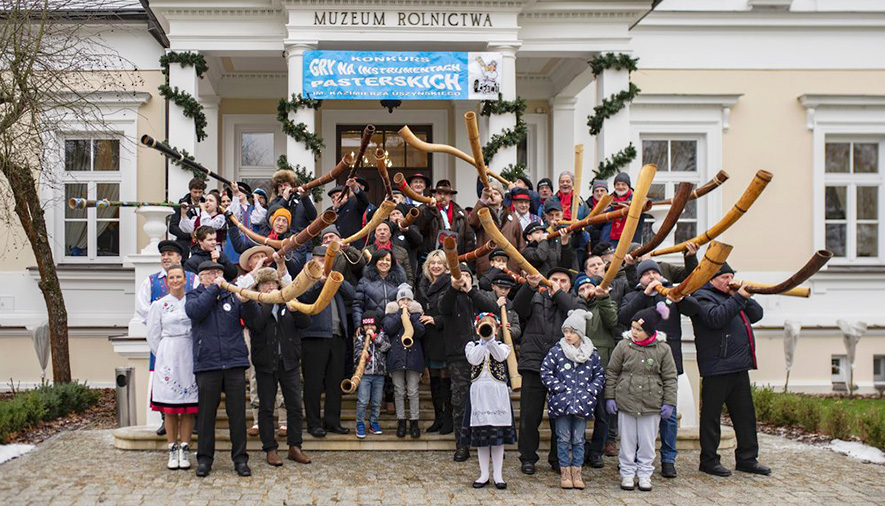
Competition: Shepherd’s Horn Games
In the years that followed, the competition evolved from a regional to a nationwide event. In addition to ligawkas, wooden shepherd’s horns from other regions of Poland were also featured: the trombita from the Carpathian regions of southern Poland and the bazuna from the Baltic region of Kashubia. Starting in 1994, the event was expanded to include other folk music instruments such as flutes, pipes, bagpipes, violins, accordions, and many more. For several years now, individuals and ensembles from abroad have also been invited. They bring instruments typical of their countries, such as the fujara (Slovakia), the bukkehorn and lur (Norway), the reed flute (Finland), the bark horn (Estonia), the winterhorn (the Netherlands), or the Swiss alphorn.
Special emphasis is placed on promoting youth participation, with separate categories for young people in each discipline. In this way, the event contributes to the revival of folklore and the exchange of experiences across generations in the field of music-making. While Ligawkas were once played exclusively by men, the competition now attracts great interest from girls as well.
On the first Sunday of Advent, Mass is celebrated at the church in Ciechanowiec with the participation of numerous folk musicians. This is followed by the awards ceremony for the various categories.
In 2026, the competition will be held for the 45th time.
Construction
Traditional description: “The process of making a horn begins by removing knots from a suitable branch, peeling off the bark, and smoothing the surface. The branch is then cut in half with a saw. The two halves are carefully hollowed out so as not to damage the walls. Precision is required, as thin walls produce a better sound. After sanding the inner surfaces, the halves are joined together with a binding agent—formerly resin or pitch, today glue. Next, rings are attached—formerly made of root wood, willow twigs, or bark, but today often made of string. The mouthpiece is firmly attached to the instrument and can come in various shapes and sizes.”
The modern ligawka is 90–180 cm long, sometimes straight, more often slightly curved, and widens at the end to form a bell.
In the past, the Ligawka was built in the fall so that it would be particularly airtight during the Advent season. Today, the prevailing view is that the wood for the Ligawka should be allowed to dry throughout the year so that it retains its shape permanently. To make the Ligawka watertight, it was often placed in water—for example, in a well trough—so that the wood would swell.




Playing Style
Four to five notes are sufficient for traditional shepherds’ calls and Advent melodies. For this, the instrument should be at least 120 cm long. In the past, the ideal length was specified as “2–3 ells.”
Most calls and melodies are variations on a common basic form and sound very similar. The call usually begins with the ascending triad so-do-mi. Within this range, the sequence of the three notes is then altered and rhythmically varied. Experienced players expand the melody with the higher natural tones so and la. Overall, therefore, the notes from the 3rd to the 7th natural tone are used almost exclusively. The length of the ligawkas is not standardized, so harmonic or polyphonic playing does not actually occur. However, it does happen that several wind players play simultaneously, which can then sound relatively dissonant. Source: Notes by Stanislaw Remiszewski, research associate at the Muzeum Rolnictwa, Ciechanowiec
Leave a Reply